◀️ Previous Article | ▶️ Next Article | 📚 The Series Index
Executive Summary
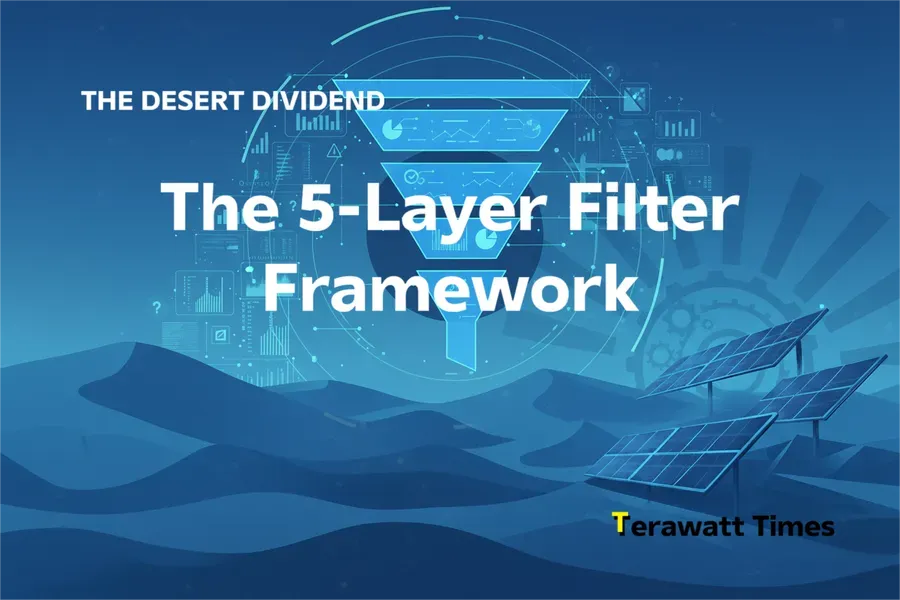
Cheap LCOE no longer guarantees survival in desert solar. The real test is endurance—through policy swings, grid bottlenecks, water scarcity, and the final sale. From two hundred project post-mortems, a pattern emerges: winners nail five factors, losers miss at least one.
The Master Framework distills this into a five-layer filter that actually works:
- Policy environment (30%)
- Resource and location (25%)
- Technical design (20%)
- Team and execution (15%)
- Exit clarity (10%)
These weights aren't academic theory—they're battle-tested. In Argentina's policy chaos, Layer 1 jumps to 40%. In Rajasthan's water crisis, Layer 2 dominates. In liquid U.S. markets, all five layers matter equally.
Here's the counterintuitive part: ecology doesn't boost IRR directly. Instead, it slashes discount rates. Projects with verified water efficiency and biodiversity metrics secure 50–100 basis points lower WACC. That's often the difference between breaking ground and staying on paper.

The Five-Layer Filter System
Layer 1: Policy Environment (30%)
What to ask:
PPA locked for 20+ years? Any history of governments tearing up contracts? Can offtakers actually pay? Will curtailment compensation actually get paid?
How to score:
- 90–100: Rock-solid PPA, enforceable protections, boring stability
- 70–89: Good framework, minor doubts
- 50–69: Real risk, needs hedging
- <50: Avoid unless structural reform is underway
Morocco (Noor): Those 20–25-year PPAs, backed by IFIs and concessional finance, create a strong baseline. CSP's higher capex was bridged by low-cost debt through CIF and World Bank support rather than pure subsidies; if those fiscal arrangements shift, risk premia will rise. MASEN, the offtaker, depends on sovereign guarantees that assume stable phosphate revenues—a dangerous assumption given global fertilizer market volatility. Score: 85
India (Bhadla): Federal solar missions provide cover, but remember Andhra Pradesh 2019? The state announced 30% tariff cuts on signed PPAs. Developers sued, projects stalled, investors fled. Payment delays now average 8–12 months. The pattern repeats: Gujarat (4-month delays), Tamil Nadu (6-month average), Karnataka (attempting retroactive cuts). Payment risks persist, but LPS rules have cut overdue balances materially since 2022; late-2024 snapshots show outstanding dues in the high-single-digit billions (USD). Score: 75
The failure nobody talks about: Spain's 2013 overhaul triggered dozens of arbitrations; potential liabilities discussed around the €10bn mark, with selective awards paid and others still contested. Developers with "ironclad" contracts lost significant revenues. The precedent haunts European renewable investment—if Spain could change terms retroactively, who's truly safe? Even Germany's Energiewende faced curtailments without compensation, challenging the myth of developed market stability.
Hidden policy killers often missed in diligence:
- Local content requirements that suddenly spike costs 20-30%
- Grid codes that change mid-construction requiring equipment swaps
- Tax holidays that evaporate when governments change
- Environmental regulations that retroactively require expensive upgrades
- Labor laws that transform O&M economics overnight
Layer 2: Resource and Location (25%)
What to verify:
Transmission under 200km and actually available? Water locked for 10+ years at prices that won't explode? Land costs below 5% of CAPEX? Do locals want you there?
How to score:
- 90–100: Perfect site—secured grid, water, land, and love from locals
- 70–89: Strong site, one or two fixable problems
- 50–69: Workable but expensive
- <50: Fatal flaws lurking
Chile (Atacama): Irradiance charts make investors drool—2,700 kWh/m²/year delivers $20/MWh LCOE. But transmission runs 600km through mountains. Water? Miners will outbid you every time. Projects face mid-eight-figure transmission upgrades. The elevation changes require intermediate substations every 150km. Seismic reinforcement for earthquake zones adds 15-20% to infrastructure costs. Environmental permits for transmission through protected vicuña habitat took 3 years. Score: 75
Remaining content is for members only.
Please become a free member to unlock this article and more content.
Subscribe NowAuthor

Alex is the founder of the Terawatt Times Institute, developing cognitive-structural frameworks for AI, energy transitions, and societal change. His work examines how emerging technologies reshape political behavior and civilizational stability.
Sign up for Terawatt Times newsletters.
Stay up to date with curated collection of our top stories.